
The Mythical Number Nine
Or how Ariadne diverted from her favourite (and the best) number to create disruption and devastation.

I shared a post on March 30 about my favourite number - which you can read via the link below - but after several pieces of encouragement, and reflection on which other numbers are important within my creative life, I decided to share my research, and rationale, for why the number nine makes an appearance in a few of my stories.
Unlike my thoughts on the number five, the number nine was only really seen amongst the cohort of all odd numbers - in that, I liked it. I like all odd numbers.
(And numbers which are binary - because, who doesn’t love being able to talk in ones and zeros? There’s a story in The Menagerie which features a binary exchange, which is correct though I don’t provide a translation for it in the book.)
Path To The Dark Moon is very much associated with the number seven; something which ties to the number nine.
But, in later life, nine became more relevant. Especially during my research and development for my Elemental Pentology, and later in Vore.
I avoid even numbers wherever I can as, in Russian custom, even numbers are associated with death and mourning (which is why, in Alabaster, Katya leaves an even number of flowers on the grave of someone she cares for) because, as per the Russian proverb:
Беда никогда не приходит одна1
As a pagan, Norse mythology is already a large part of my life. The number nine isn’t only important in Norse culture; however, this is where I’m going to start.
The number nine is documented within both Norse myths and culture, and some of these instances include:
Odin’s self-sacrifice, hanging on Yggdrasil for nine nights, leads to him gaining profound esoteric knowledge of the runes and eighteen magical songs;
To retrieve Baldr, Hermodr spends nine nights in Hel;
Thor can take nine steps after his battle with the Midgard serpent before he dies;
Heimdallr was born to nine mothers;
The Valkyries are often depicted in groups of nine;
Freyr had to wait nine nights for his marriage to Gerd;
Skaði and Njörðr lived alternately for nine nights in Nóatun and in þrymheimr;
Menglöð has nine maidens to serve her;
There are mentions of feasts which last for nine days, where nine male victims from a different species are sacrificed each day at Uppsala Temple - with a similar ritual documented in Lejre, Denmark.
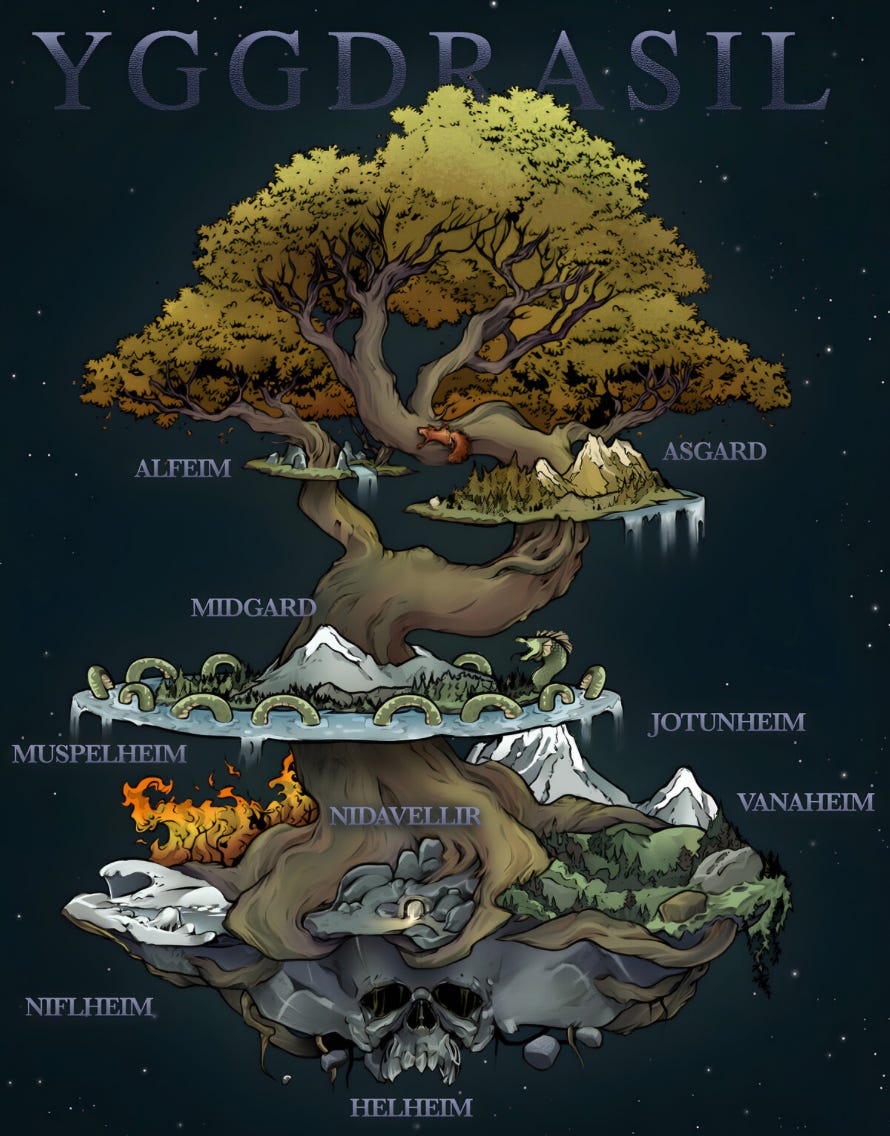
Yggdrasil holds the Nine Worlds (Níu Heimar) in the branches and roots - though it is modern interpretation which has placed the various worlds where they are on the tree. The placement is purely speculative. The Poetic Edda makes reference to the Nine Worlds, but there is no source which lists exactly which realms make up these nine predominantly invisible worlds. But, the general consensus provides:
Midgard (the world of humanity);
Asgard (the world of the Æsir - gods and goddesses);
Vanaheim (the world of Vanir tribe of deities);
Jotunheim (the world of the giants);
Niflheim (the world of ice);
Muspelheim (the world of fire);
Alfheim (the world of the elves);
Nidavellir / Svartalfheim (the world of the dwarves);
Hel (the world of the Goddess Hel, and the dead) - there are nine rivers in Hel.
Each of these nine worlds are distinct dimensions - which aligns with modern String Theory. String Theory proposes ten to twelve dimensions, and if the three dimensions perceived by humans are removed, then this results in nine dimensions, which mirrors the Norse myth and spiritual beliefs.
The Norns (a trio) are expanded to nine in some sources. Three groups of three Norns are associated with the Æsir, elves, and dwarves - creating a complex structure of fate and destiny. (This also links into the idea of three times three.)
In the Norse epic Völundarkviða, the narrative tells of three Valkyries who lose their swan pelts to three brothers for nine years. After which, they reclaim them and escape - illustrating the theme of a nine-year cycle of captivity and liberation.
Though the exact nature of what spiritual or magical significance the number nine had for pre-Christian Germanic and Norse people, there are references to how important it was in a variety of different sources. One theory is that the importance stems from the lunar calendar having 27 days - therefore a multiple of nine - at the time - something which was linked to the sacredness of pregnancy.
The number nine has maintained a strong pagan presence, despite the way it transitioned to the number seven after Christianisation. The cultural significance has continued to today in both ritual and legislative forms.
Up to the 1800s, to cure a toothache, the Swedish guidance was to get a twig from nine different fruit trees and pick the tooth that aches, and put the twigs in an anthill in the north part of a farm. In the 1700s, to make a love spell nine drops of water from a river where there is a whirlpool is required, and those drops are then sprinkled on the one you want to fall in love with you.
It isn’t just in Norse mythology where the number nine takes on importance. In mathematics, an odd perfect number will have at least nine distinct prime factors.
Multiples of three are very important within pagan cultures, and certainly Germanic ones - and for witches (which I’ll revisit in a future post).
And, of course, three times three is nine.
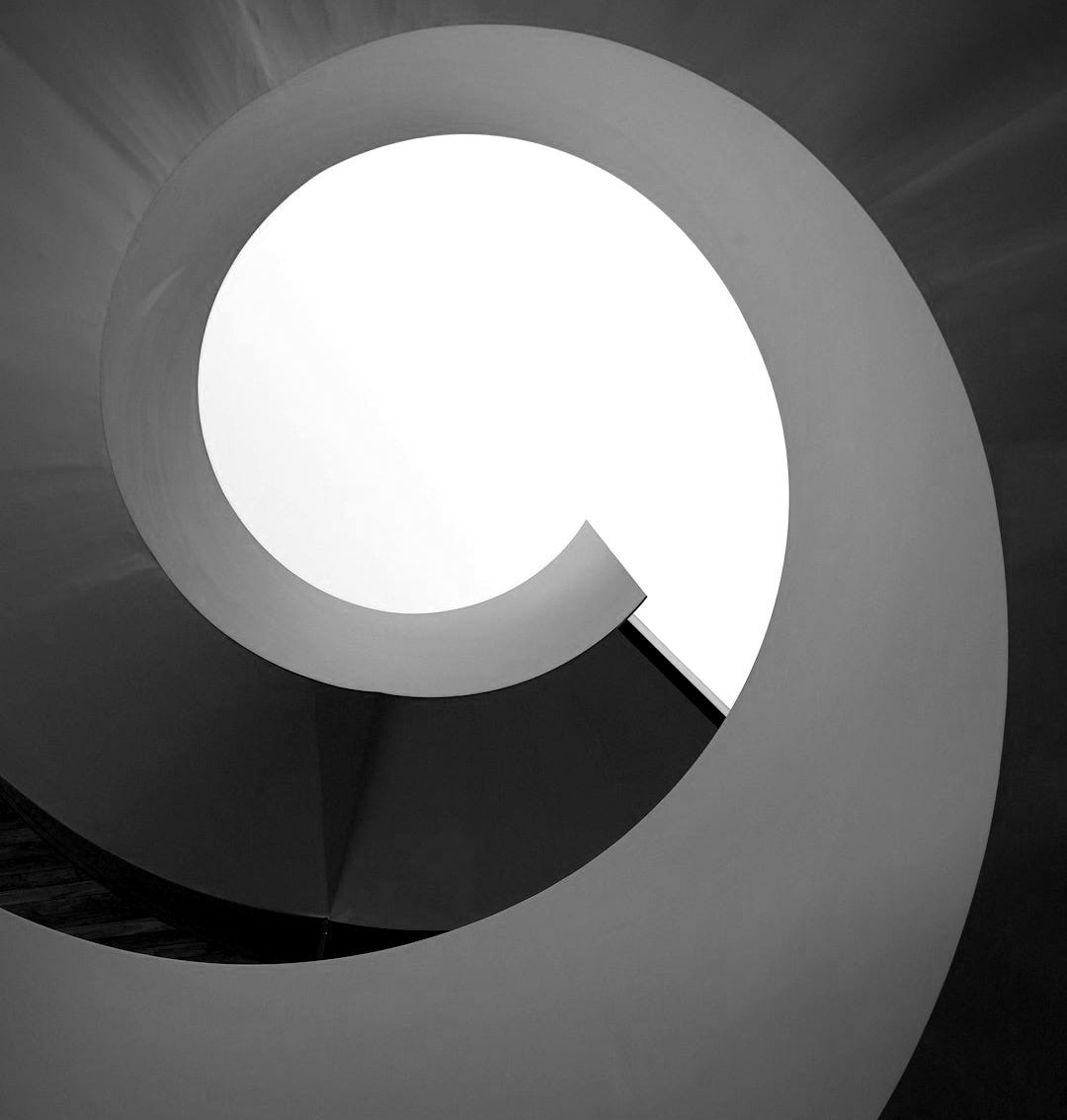
The number nine represents completion but not finality - it is about ending one cycle and the potential it creates for another cycle to begin. It ushers in transition, guidance, and empowerment through wisdom.
Pliny the Elder (Greek) mentions that one individual from each generation was required to transform into a wolf every nine years - another example of the number nine being linked with a cycle of transformation. Also in Greek mythology is the use of a nine-year cycle for reincarnation of virtuous souls - something reflected in Persephone’s restoration of souls every nine years. There are also nine muses.
In Ancient Egypt, the Ennead is a group of nine gods.
Hindu’s have nine universal substances - Earth, Water, Air, Fire, Ether, Time, Space, Soul, and Mind.
In Chinese culture, the number nine is associated with the Chinese Dragon - a symbol of power and magic. There are nine of these dragons, and they are described in terms of nine attributes, and they have nine children. The dragons also have 117 scales, divided into 81 yang (masculine) and 36 yin (feminine). All three of those numbers are multiples of nine.
The Buddhist practice involves mantras chanted 108 times - a multiple of nine. The number 108 is also evident in Vedic texts, and holds great importance.
The number nine is also presented in idioms - cats have nine lives, we can go the whole nine yards, and find complete bliss on cloud nine.

The Elemental Pentology
Though the number five is the key number within this series, the number nine makes a significant statement within it (and, of course, within astrology the quintile is 72 degrees and seven plus two is… nine). The Pentology has several threads which run through it, and one of those is heavily Norse-influenced.
One of the male characters could be seen as symbolic of Thor. Another as symbolic of Baldr. And there are certainly suggestions of Ragnarök and (nightmare) visits to Éljúðnir - the home of the Goddess Hel. A recurring symbol is also Yggdrasil - both as artwork in characters’ homes, and in a giant stained glass window, and a tattoo (amongst other Norse-style tattoos).
Yggdrasil holds nine worlds.
And though there is a scene in another world when the Goddesses are exiled (the timeline is… twisty), I wanted to reflect the concept of Yggdrasil in a location for a truly pivotal and utterly devastating moment in the story. The island of Dominica has nine volcanoes which run the spine of the island. And being an island also leant itself perfectly to the talents I’d given the Goddesses - especially the Goddesses of Air and Earth - due to the isolated nature of an island.
A little background - one of the scientists in the story wished to harness the elements with machines to create a new power source. He used old Soviet research from the Vector Institute, which unlocked ancient viruses in the permafrost, and the discovery of a subatomic particle which was influencing forms and matter that weren’t yet known to science2. He worked with these palaeoviruses, cybernics, quantum creation, and nanotechnology… and more… creating a portal, of sorts… but as for how all that weaves together… you’ll have to read the Pentology to find out!
Volcanoes bring dead material to the surface when they erupt. And such a catastrophic event isn’t entirely unexpected - at some point, the potential for a disease we can’t fight could be realised (because the virus released is so old, and we’ve destroyed any potential antidote due to how we’ve used the world).
So - Yggdrasil, Dominica, nine volcanoes, palaeoviruses with no cure… a pretty catastrophic event if every volcano was to erupt at once. But at least there are some Elemental Goddesses around who can help prevent things getting too bad, right?
Right?
And I’m a lovely author who would never cause so much harm.
This happens in Sempiternal - the fourth book - and there’s another book which follows that. But, the timeline is very complicated, so… no guarantees.
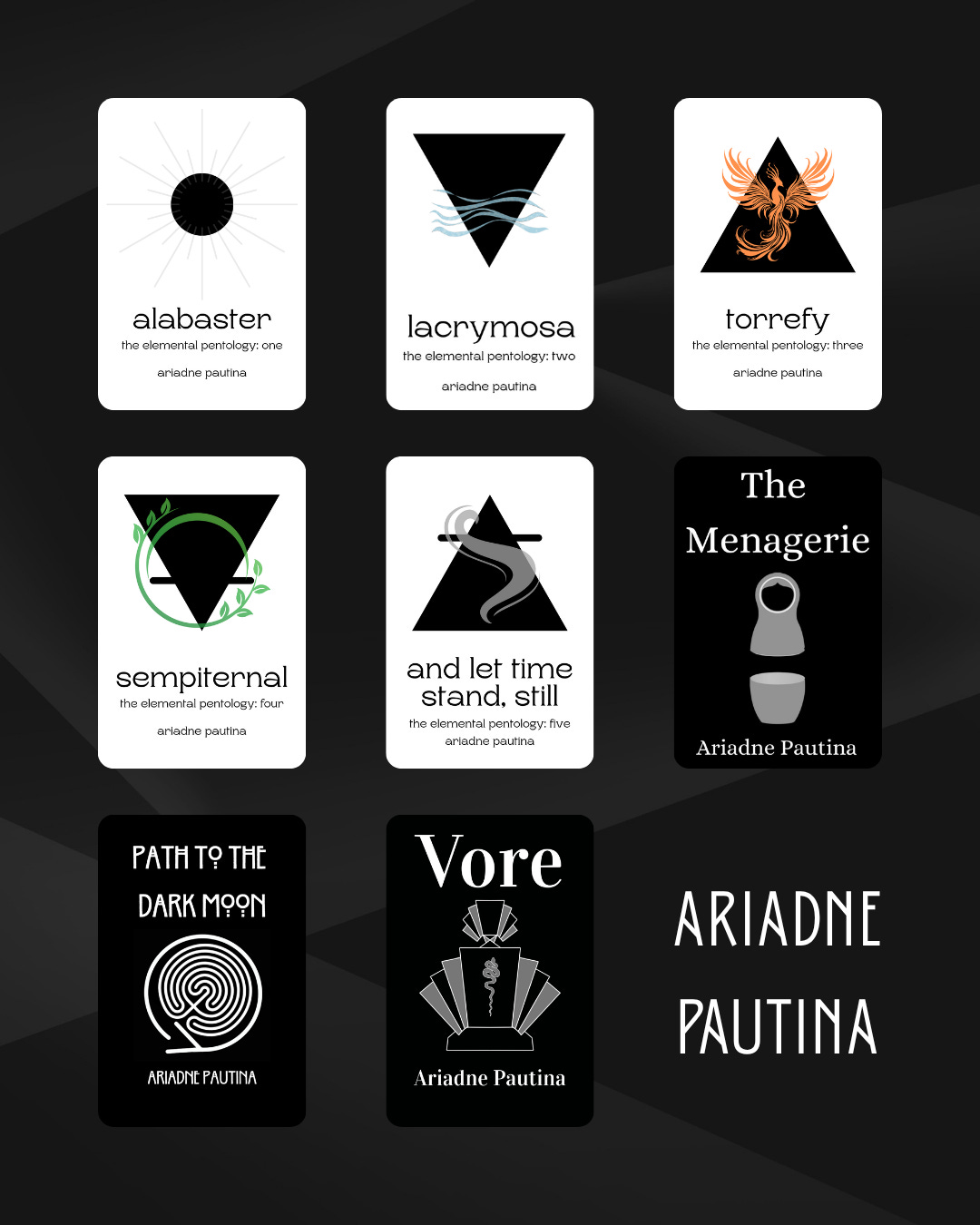
Vore
In Vore, there is a Norse-influenced crime organisation called Septer. Though none of the men within this group are of Norwegian origin, they are desperate to emulate quite stereotypical traits of Norse culture. This includes things such as their hair styles, tattoos, and the name for their gang, and some of their clubs.
Though not as overt as the use of the number nine within the Pentology, I opted to use eight to highlight how Mace failed to accommodate the mythical power of the number nine - despite all his Norse knowledge and attempts to prove himself a true Norseman - when he sent eight men to attack Vadim’s warehouse.
The attack failed, because (partly) he didn’t choose nine men.
Only two of the eight men were still alive. They were back to back and naked. Plastic ties bound their wrists and nails held their feet flush to the swept floor. Blood painted their skin, pooled around their limbs, and meandered closer to the bodies piled to one side; clothed and ready to be discovered.
© Vore, Ariadne Pautina, 2026 [extract from the book]
Of course, he sent eight men as a distraction in a later scene - but, those paying attention, will also have noted the addition of others involved who play a more pivotal role during that… incident. So, technically - not eight.
But, considering that eight is seen as a bad number for Russians, it was a compromise which worked to convey the impact such a decision had.
I put a great deal of thought into what I write - probably more than anyone will ever, ever know about.
Discover more about Ariadne’s books on her website, or obtain via the method you find most called to pursue.
Thank you for reading; I appreciate your time and your support. If you feel called to leave an offering, it would be sincerely welcome. But, your company is gratefully received regardless 🖤
Беда никогда не приходит одна - literal translation: ‘trouble never comes alone’, but can be seen as the equivalent English proverb ‘it never rains but it pours’
This is all accurate and true - the Vector Institute, the viruses in the permafrost, and also the subatomic particle ‘misbehaving’ is all (was all) published research at the time I wrote the Pentology.
Nine as a symbol of cycles, representing completion without finality.
I love how numbers play an important part in your works. I didn't know that 9 was such an important part of Norse mythology. Loved it.